Earlier that day, the Prince of Wales held an investiture ceremony at Windsor Castle, where he handed out more than 50 honors. Among the recipients was Patricia Sprouse who later took to LinkedIn to share the news of her honor. In her post, she revealed some details regarding Kate and the much-needed help she gets.
“What an amazing experience, the castle was just breathtaking, everyone was so lovely to us as we were just in awe of everything,” Sprouse wrote on LinkedIn. “Prince William said that Catherine had two Filipino nurses looking after her and they were amazing and kind.”
Rted Postsela
She stunned the world in Malèna—but what Monica Bellucci chose to do after may be her boldest act yet

In the early 1990s, Monica Bellucci was already a recognized face in Europe. Her modeling career was flourishing, her name graced the pages of fashion magazines, and she was gaining momentum in the film industry. But it wasn’t until her fearless performance in Giuseppe Tornatore’s
Malèna (2000) that her place in cinematic history was secured.
Set against the backdrop of World War II in a conservative Sicilian town, Malèna tells the story of a woman whose extraordinary beauty isolates her from the very society that obsesses over her. Monica Bellucci played the title role with astonishing restraint—speaking few words, yet conveying a universe of emotion. The role demanded subtlety and strength: sorrow, dignity, and suppressed rage, all captured through the tiniest expressions and glances. In a performance that defied the need for dialogue, Bellucci communicated everything.
She didn’t just portray Malèna—she became her. Critics and audiences alike were captivated not only by Bellucci’s physical presence but by the profound humanity she brought to the role. It was a reminder that beauty on screen could be as much a burden as a gift. And in the hands of a masterful actress, it could also be a powerful tool for storytelling.
From Law School to the Runway
Monica’s rise to fame was far from conventional. Born in 1964 in Città di Castello, a small town in Italy’s Umbria region, she initially studied law at the University of Perugia. To support her studies, she began modeling—and it wasn’t long before the fashion world took notice. Soon, she was walking for designers like Dolce & Gabbana and appearing on the covers of
Elle and Vogue.
But Bellucci never saw modeling as her endgame. In fact, she resisted being boxed in by the expectations that came with being a model-turned-actress. Unlike others who made similar transitions for the allure of fame, Bellucci’s move into acting was a deliberate act of reinvention. In her 30s—an age at which many actresses are already being pushed to the margins—she committed herself to film.
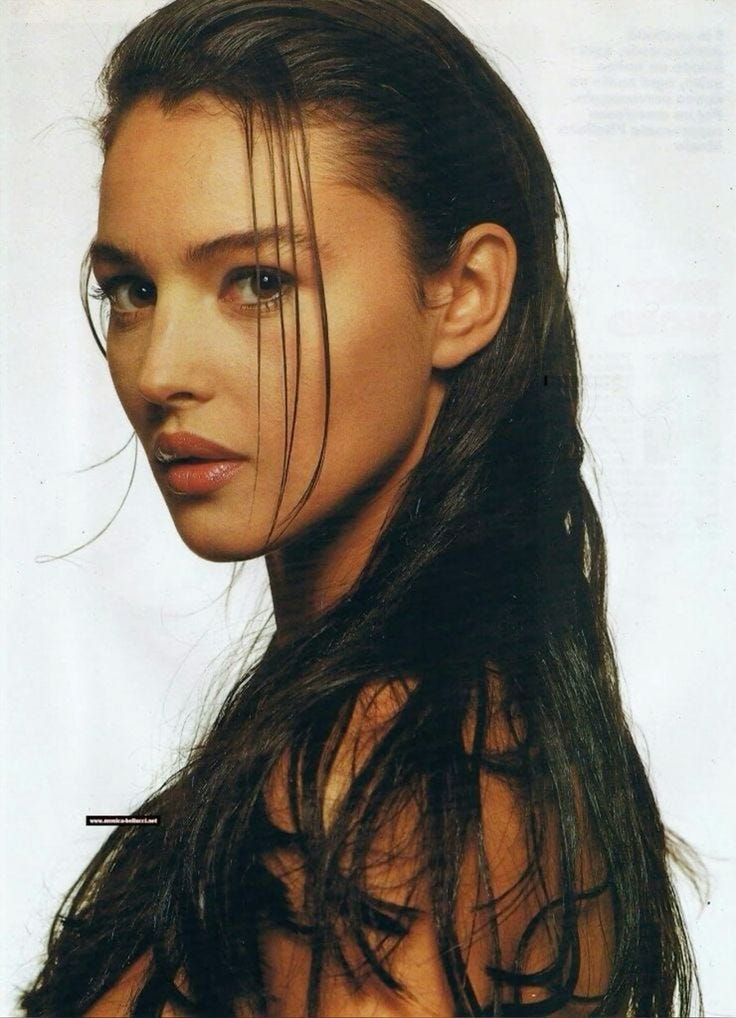
Beauty with Depth
Skepticism followed. Some critics questioned whether someone as traditionally beautiful as Monica could truly be taken seriously as a performer. But she challenged those doubts head-on, taking on roles that revealed vulnerability, complexity, and courage. From romantic leads in French cinema to bold roles in Hollywood and daring independent films, she refused to let her looks define her.
Films like Irreversible (2002), The Passion of the Christ (2004), and The Apartment (1996) demonstrated Bellucci’s ability to embrace emotionally raw, physically demanding roles. She became known for her nuanced performances, for choosing scripts that asked difficult questions, and for portraying women with internal lives that stretched far beyond their appearances.

Aging on Her Own Terms
One of the most compelling aspects of Monica Bellucci’s journey is how she has navigated aging in an industry obsessed with youth. Unlike many of her contemporaries, she has never attempted to freeze time. She’s spoken openly about the pressure placed on women to look younger, yet she has remained unapologetically herself.
Her role as a Bond woman—distinctly not a “Bond girl”—in Spectre (2015) was a defining moment. At 50, she was the oldest woman ever cast opposite James Bond. But she didn’t accept the part as a novelty; she saw it as a statement. “It was a victory,” she said, “to show that a woman of my age can be sensual, can be powerful.”
Her attitude toward beauty is both radical and refreshing. “Real beauty is to be true to yourself,” she once remarked. And in every public appearance, every interview, and every role, she has modeled exactly that.

More Than a Muse
Though frequently described as a muse for directors and designers, Bellucci has always been the author of her own narrative. She is fluent in multiple languages, chooses her projects with care, and has been known to turn down roles that don’t align with her values. Whether in Italian, French, or English, she brings an intelligence and introspection to her performances that defy the clichés attached to her physical image.
She’s also managed to keep much of her personal life private—a rare feat in the age of constant exposure. Her dignity, grace, and quiet strength have made her not just an actress or a model, but a symbol of self-determined womanhood.

Legacy in the Making
Even into her late 50s and beyond, Monica Bellucci continues to act, to captivate, and to evolve. She has portrayed opera singers, queens, witches, and lovers—always with a blend of elegance and intensity that makes each performance memorable. Her legacy is still unfolding, but one thing is clear: she has never settled for being seen only as an icon of beauty.
Monica Bellucci’s life and career defy the idea that women must choose between being admired and being respected. Her story is a testament to reinvention, resilience, and authenticity. In every era of her career—from modeling’s spotlight to cinema’s shadows—she has shown that true allure comes not from perfection, but from presence.
And as the industry slowly begins to catch up with the ideals she’s embodied for decades, Monica Bellucci remains ahead of her time—mysterious, magnetic, and magnificently her own.
Mystery Behind Barron Trump’s Disappearance from NYU Campus Revealed